What to eat and drink during a marathon?
The Vegan Athlete - What to eat and/or drink during a marathon run. By Yotam Kaplan
Visit Yotam's Instagram account
In our previous article, we explained what you should eat before a marathon and why.
Today we will talk about what to eat/drink during the race, if at all.
During an intense run, our body's primary fuel is glycogen, which is the body's immediate carbohydrate store.
Even if we performed carb-loading properly, in longer distances (half marathon and full marathon), our body will burn more carbohydrates than are available in our stores.
In such a case, the body will need to rely on a different type of fuel (fats, for example) which requires a longer breakdown process that demands energy and can impair our performance.
To avoid reaching this state, we want to fuel the body during the competition.

So how do we do it?
First of all, let's differentiate by race distance as we did in the previous article.
Runners of 5/10 km do not need to provide the body with energy during the run due to the relatively short duration.
In contrast, half/full marathon runners do need to fuel during the run, and it is crucial to be consistent about it.
What is the rule of thumb?

We want to intake about 100 kcal every 40 minutes.
This can be done in various forms, for example: energy gel (almost all are vegan but it's worth checking), 2 dates, 3-4 dried apricots, a can of cola, and more.
As a rule, it is best to do what feels right for your body and what you have practiced during your training runs (if you haven't tried it yet, now is the time).
While I am not a fan of gels and am even somewhat repulsed by their taste, in a race, convenience is an important factor, which is why I choose to use them.
Again, the most important thing is not to try anything new on race day (not even a new type of gel) and to come prepared in advance; you can't predict how your body will react and you don't want to test it then.
Two additional things we need to replenish during the run are: electrolytes (salts) and fluids.
Electrolytes
Recently, awareness of salt tablet consumption during long runs has increased, but every year there are still runners who are unaware of this and put their bodies at risk.
Half marathon runners generally do not need to take salt tablets unless the run duration exceeds two and a half hours, or if it's an exceptionally hot day, or if they know they tend to sweat excessively.
Full marathon runners should take a salt tablet every 45-60 minutes depending on the weather that day and personal sweat rates (electrolyte loss).
Fluids
No less important than nutrition, and perhaps the most critical topic. Every year, many people become dehydrated during the marathon because they don't drink enough fluids during the run.
For some, it leads to mild dehydration that impairs performance, while others seriously endanger their bodies and end up collapsing.
There are plenty of water stations during the race; it is very important to take a few sips at each one, even if you don't feel particularly thirsty.
Sometimes we don't feel thirst and might even feel that drinking water is a burden, but that doesn't mean the body isn't losing essential fluids that need to be replaced.
By the time the sensation of thirst arrives, it is sometimes already too late.
Conclusion:
Therefore, it is important to take a few sips at every station right from the start of the run to avoid reaching a state of dehydration.
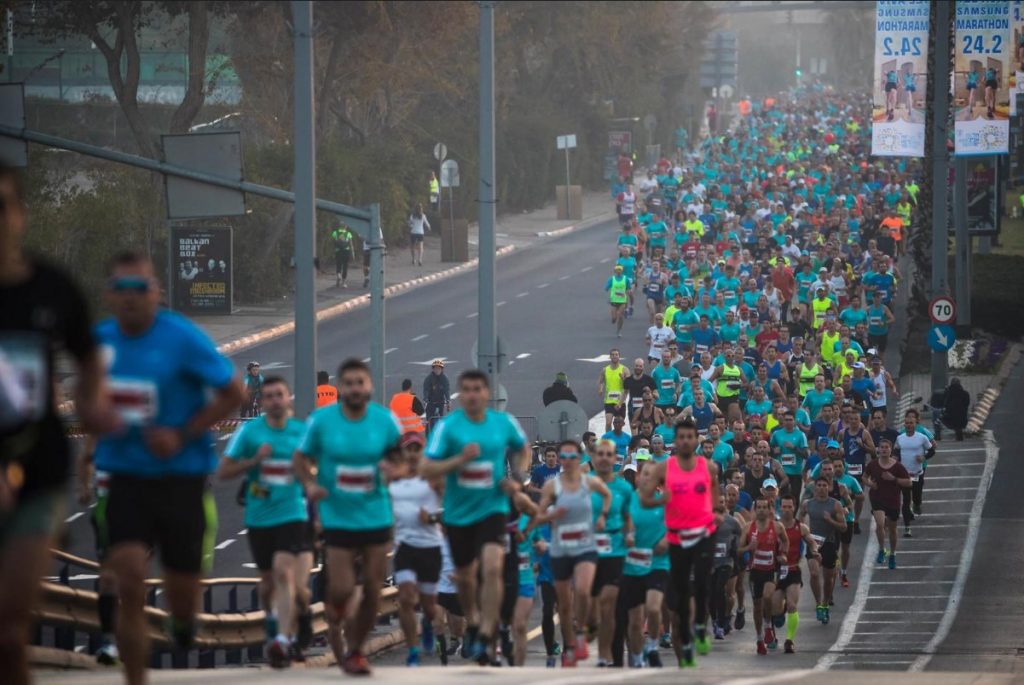
Unfortunately, I experienced the consequences of this recommendation firsthand during the Tel Aviv full marathon two years ago, where I became dehydrated.
This caused me to miss my target time and made the last 10 kilometers the longest of my life.
Of course, hydration must also be practiced during training runs.
If possible, place a bottle along your route, ask a friend or family member to wait for you with a water bottle and some encouragement, or stop for a moment at a water fountain.
Naturally, there is no single correct answer for exactly how much to drink; it depends on the runner's weight, sweat rate, the weather, and other factors. Just make sure you are listening to your body and taking a few sips at every station, even if you don't feel the need.
Summary:
In this article, we reviewed how to fuel the body during a marathon and if it's even necessary.
I hope I managed to clear things up a bit. Feel free to ask any questions that arise.
In the next and final article, we will talk about the best part... finishing the race!
How should we nourish our bodies then?
Spoiler—it’s not the yogurt that Muller ambassadors or any other company will hand out at the finish line.
Vegan coaches, nutritionists, and physiotherapists interested in publishing on "The Vegan Athlete" are welcome to send proposals to: lefflerpro@gmail.com